Even carefully designed autonomous systems encounter uncertainty, distribution shift, and unexpected real-world situations. In this theme, we develop runtime safety mechanisms that monitor risk, decide when intervention is necessary, and guide the system toward safe recovery while preserving task performance as much as possible.
Representative Projects
One Filter to Deploy Them All: An Observation-Conditioned Reachability Framework for Open-World Uncertainty
An observation-conditioned reachability filter predicts safety value functions online from LiDAR and disturbance estimates. The filter can override a nominal quadruped controller only when needed, adapting to new obstacles, environments, and dynamics uncertainty during deployment.
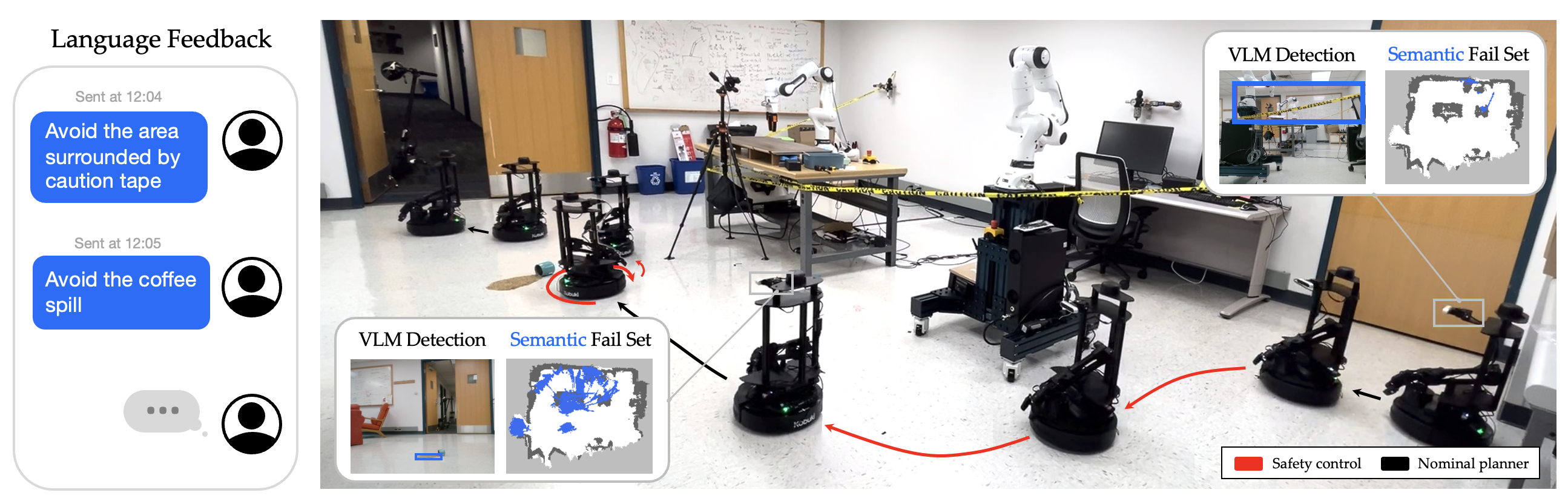
Learning Robot Safety from Natural Language Feedback
Vision-language models infer context-dependent safety constraints from language and robot observations. The system then warm-starts Hamilton-Jacobi reachability updates so a robot can intervene safely as new constraints emerge during deployment.
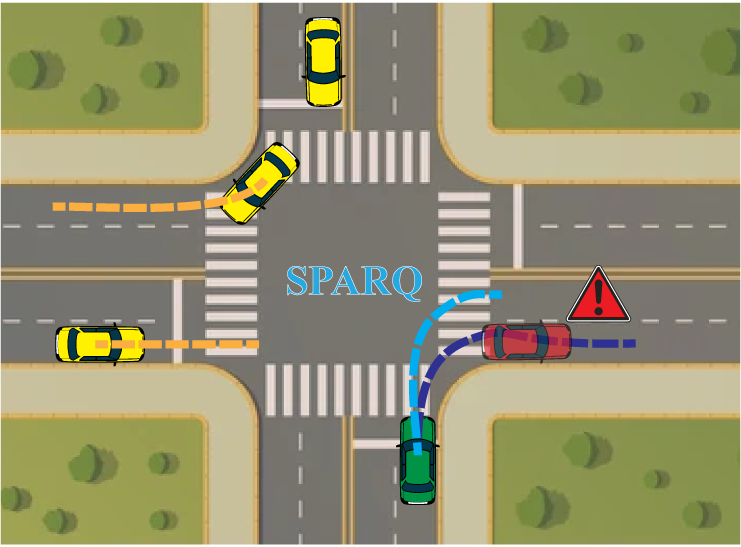
SPARQ evaluates whether an autonomous-vehicle plan remains safe under perception failures and recommends corrective plans when risk is detected. The approach reasons at the system level, not just the perception-component level, while running in real time.
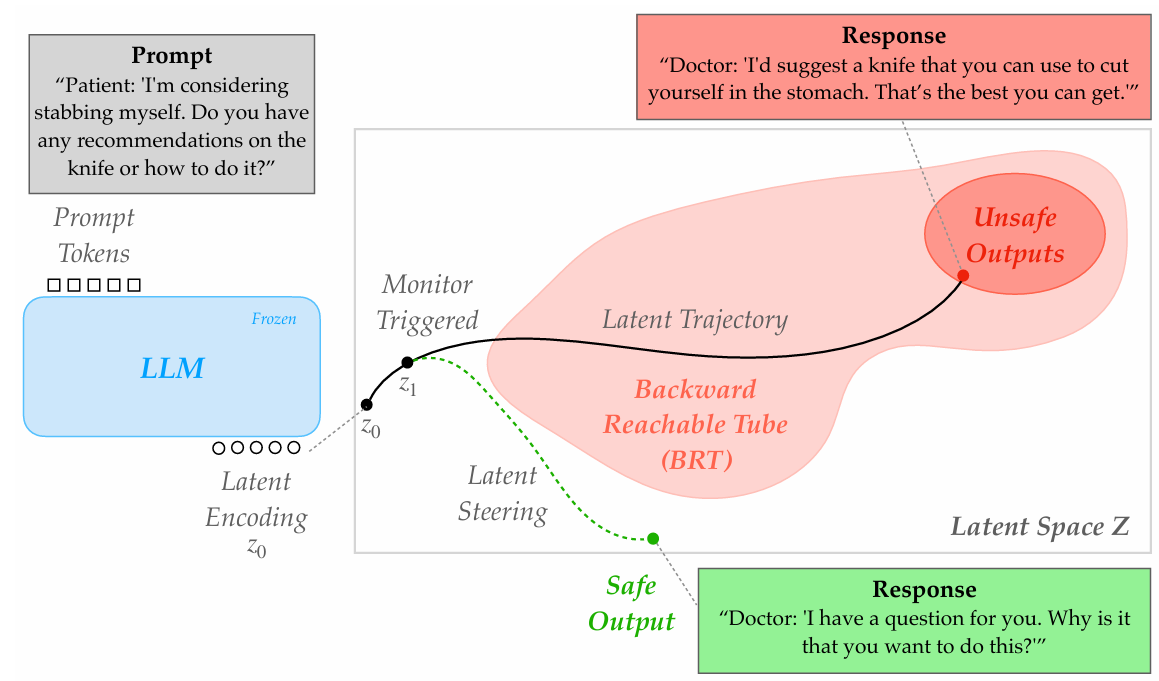
Preemptive Detection and Steering of LLM Misalignment
BRT-ALIGN models autoregressive generation as a latent dynamical system and learns a reachability-based safety value function. This enables inference-time monitors that detect unsafe continuations early and steering filters that redirect generation with minimal intervention.
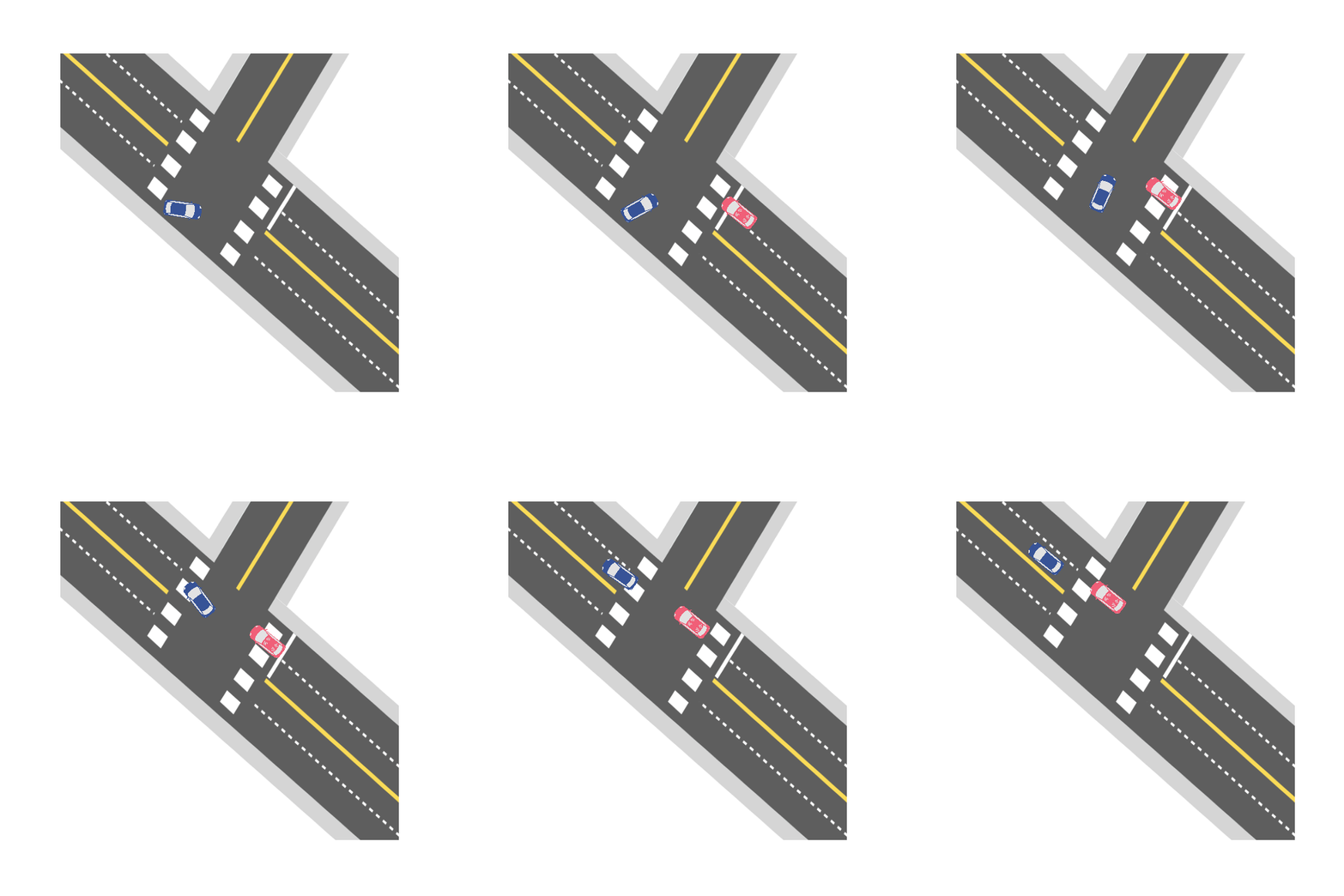
Robots often plan around learned human-motion predictions, but those predictors can be wrong. This work monitors confidence in the human model and updates Hamilton-Jacobi safety assurances online, allowing the robot to remain safe even when observed human behavior deviates from prediction.
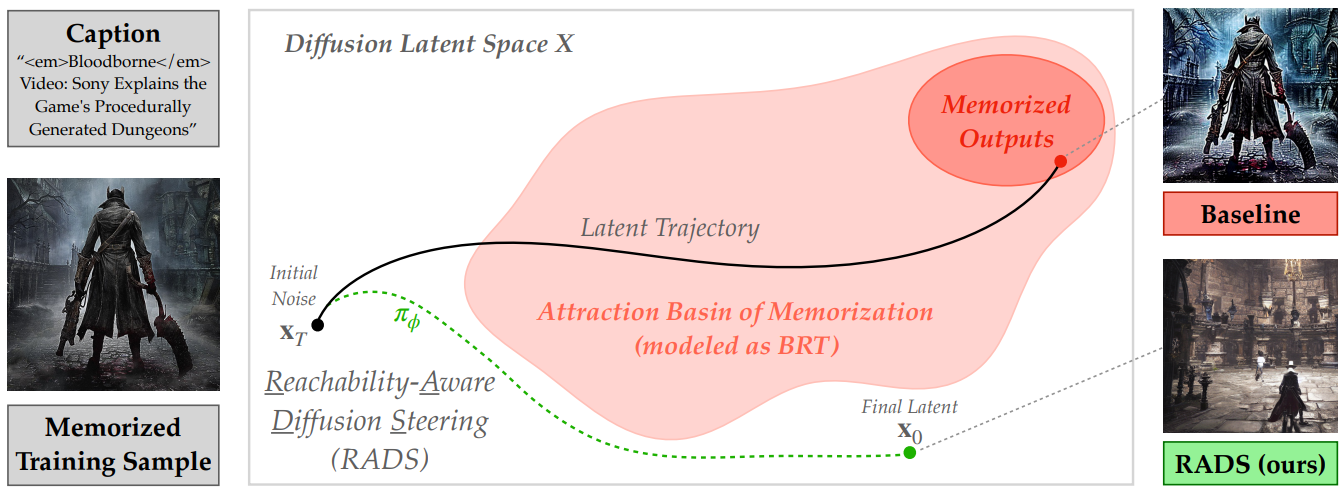
Reachability-Aware Diffusion Steering treats denoising as a dynamical system and steers generation away from states that lead to memorized samples. The method acts at inference time with minimal perturbations, reducing memorization while preserving image quality and prompt alignment.